Showing posts with label integration. Show all posts

Saturday, January 5, 2019

Spring MVC: unit and integration tests

1.Intro 

Spring MVC is the one of most popular framework for REST services in java. Let's see how can we test our Spring MVC rest serves.

2. Project structure

I created simple gradle spring boot project. It has beside main app starter  just one rest controller (UserController), two domain entities (Greeting, User) and test: unit and integration.


3. build.gradle

Beside spring-boot dependencies I just added Lombok to reduce some boilerplate code for domain objects. 

buildscript {
   ext {
      springBootVersion = '2.1.1.RELEASE'   }
   repositories {
      mavenCentral()
   }
   dependencies {
      classpath("org.springframework.boot:spring-boot-gradle-plugin:${springBootVersion}")
   }
}

apply plugin: 'java'apply plugin: 'eclipse'apply plugin: 'org.springframework.boot'apply plugin: 'io.spring.dependency-management'
group = 'com.demien'version = '0.0.1-SNAPSHOT'sourceCompatibility = 1.8
repositories {
   mavenCentral()
}


dependencies {
   implementation('org.springframework.boot:spring-boot-starter-web')
   compileOnly('org.projectlombok:lombok')
   testImplementation('org.springframework.boot:spring-boot-starter-test')
}

4. Main application starter

Nothing interesting is here. Just SpringApplication.run

package com.demien.sprmvc;
import org.springframework.boot.SpringApplication;import org.springframework.boot.autoconfigure.SpringBootApplication;
@SpringBootApplicationpublic class SprmvcApplication {

   public static void main(String[] args) {
      SpringApplication.run(SprmvcApplication.class, args);   }

}


5. Domain objects

Thanks to Lombok, my domain objects are really tiny!

 package com.demien.sprmvc.domain;

import java.util.Date;
import lombok.AllArgsConstructor;import lombok.Getter;import lombok.NoArgsConstructor;import lombok.Setter;
@Getter@Setter@NoArgsConstructor@AllArgsConstructorpublic class Greeting {
   private String message;   private Date dt;}


package com.demien.sprmvc.domain;
import lombok.AllArgsConstructor;import lombok.Getter;import lombok.NoArgsConstructor;import lombok.Setter;
@Getter@Setter@AllArgsConstructor@NoArgsConstructorpublic class User {
   private String name;}

6. Rest controller

Finally we've reached something interesting - the controller we are going to test.
I created several methods:  rest endpoints, from simple to complex:
 - "hello" - GET which is jest returning text result
 - "hello-with-object" - GET but it's returning java object. So object should be serialized and returned as JSON
- "hello-with-parameter" - GET which has a path paameter
- "helo-post" - POST which is receiving java object and returning java object as well. Of course these objects will be serialized to JSON. 


package com.demien.sprmvc.controller;
import java.net.URI;import java.util.Date;
import org.springframework.http.ResponseEntity;import org.springframework.stereotype.Controller;import org.springframework.web.bind.annotation.GetMapping;import org.springframework.web.bind.annotation.PathVariable;import org.springframework.web.bind.annotation.PostMapping;import org.springframework.web.bind.annotation.RequestBody;import org.springframework.web.bind.annotation.RequestMapping;import org.springframework.web.bind.annotation.ResponseBody;import org.springframework.web.servlet.support.ServletUriComponentsBuilder;
import com.demien.sprmvc.domain.Greeting;import com.demien.sprmvc.domain.User;
@Controllerpublic class UserController {

   private static final String helloWorldTemplate = "Hello World, %s!";   private int id = 1;
   @RequestMapping(value = "/hello")
   public @ResponseBody String hello() {
      return "Hello world!";   }

   @GetMapping("/hello-with-object")
   public @ResponseBody Greeting helloWithObject() {
      return new Greeting("Hello World", new Date());   }

   @GetMapping("/hello-with-parameter/name/{name}")
   public @ResponseBody Greeting helloWithParameter(@PathVariable String name) {
      return new Greeting(String.format(helloWorldTemplate, name), new Date());   }

   @PostMapping("/hello-post")
   public ResponseEntity<?> postTest(@RequestBody User user) {
      Greeting result = new Greeting(String.format(helloWorldTemplate, user.getName()), new Date());      URI location = ServletUriComponentsBuilder.fromCurrentRequest().path("/{id}").buildAndExpand(id++).toUri();      return ResponseEntity.created(location).body(result);   }

}


7. Unit test

And now let's check if our controller works as expected. For unit tests we're using MockMVC. And also we need ObjectMapper for JSON serialization.
Please pay attention on this  annotation:

@WebMvcTest(UserController.class)

- our mockMvc will be created for UserController class. 


package com.demien.sprmvc.controller;
import static org.hamcrest.Matchers.containsString;import static org.hamcrest.Matchers.equalTo;import static org.springframework.test.web.servlet.result.MockMvcResultMatchers.content;import static org.springframework.test.web.servlet.result.MockMvcResultMatchers.status;
import org.junit.Test;import org.junit.runner.RunWith;import org.springframework.beans.factory.annotation.Autowired;import org.springframework.boot.test.autoconfigure.web.servlet.WebMvcTest;import org.springframework.http.MediaType;import org.springframework.test.context.junit4.SpringRunner;import org.springframework.test.web.servlet.MockMvc;import org.springframework.test.web.servlet.request.MockMvcRequestBuilders;
import com.demien.sprmvc.domain.User;import com.fasterxml.jackson.databind.ObjectMapper;
@RunWith(SpringRunner.class)
@WebMvcTest(UserController.class)
public class UserControllerTest {

   @Autowired   private MockMvc mvc;
   @Autowired   private ObjectMapper mapper;
   @Test   public void helloTest() throws Exception {
      mvc.perform(MockMvcRequestBuilders.get("/hello").accept(MediaType.APPLICATION_JSON)).andExpect(status().isOk())
            .andExpect(content().string(equalTo("Hello world!")));   }

   @Test   public void helloWithObjectTest() throws Exception {
      mvc.perform(MockMvcRequestBuilders.get("/hello-with-object").accept(MediaType.APPLICATION_JSON))
            .andExpect(status().isOk()).andExpect(content().string(containsString("Hello World")));   }

   @Test   public void helloWithParameterTest() throws Exception {
      mvc.perform(MockMvcRequestBuilders.get("/hello-with-parameter/name/Buddy").accept(MediaType.APPLICATION_JSON))
            .andExpect(status().isOk()).andExpect(content().string(containsString("Hello World, Buddy")));   }

   @Test   public void postTest() throws Exception {
      User user = new User("Joe");      String userJson = mapper.writeValueAsString(user);      mvc.perform(
            MockMvcRequestBuilders.post("/hello-post").content(userJson).contentType(MediaType.APPLICATION_JSON))
            .andExpect(status().isCreated()).andExpect(content().string(containsString("Hello World, Joe")));   }

}


Results:


8. Integration test

For integration test we can not use any mocks - just real rest services. So we have to start our application
@SpringBootTest(classes = SprmvcApplication.class, webEnvironment = SpringBootTest.WebEnvironment.RANDOM_PORT)

and  test needed rest enpoints using TestRestTemplate.

package com.demien.sprmvc;
import static org.hamcrest.MatcherAssert.assertThat;import static org.hamcrest.Matchers.containsString;import static org.hamcrest.Matchers.equalTo;
import org.junit.Test;import org.junit.runner.RunWith;import org.springframework.boot.test.context.SpringBootTest;import org.springframework.boot.test.web.client.TestRestTemplate;import org.springframework.boot.web.server.LocalServerPort;import org.springframework.http.ResponseEntity;import org.springframework.test.context.junit4.SpringRunner;
import com.demien.sprmvc.domain.Greeting;import com.demien.sprmvc.domain.User;
@RunWith(SpringRunner.class)
@SpringBootTest(classes = SprmvcApplication.class, webEnvironment = SpringBootTest.WebEnvironment.RANDOM_PORT)

public class SprmvcApplicationIT {

   private static final String LOCAL_HOST = "http://localhost:";
   @LocalServerPort   private int port;   private TestRestTemplate template = new TestRestTemplate();
   @Test   public void helloTest() throws Exception {
      ResponseEntity<String> response = template.getForEntity(createURL("/hello"), String.class);      assertThat(response.getBody(), equalTo("Hello world!"));   }

   private String createURL(String uri) {
      return LOCAL_HOST + port + uri;   }

   @Test   public void helloWithObjectTest() throws Exception {
      ResponseEntity<String> response = template.getForEntity(createURL("/hello-with-object"), String.class);      assertThat(response.getBody(), containsString("Hello World"));   }

   @Test   public void helloWithParameterTest() throws Exception {
      ResponseEntity<String> response = template.getForEntity(createURL("/hello-with-parameter/name/Buddy"),            String.class);      assertThat(response.getBody(), containsString("Hello World, Buddy"));   }

   @Test   public void postTest() throws Exception {
      User userBean = new User("Joe");      ResponseEntity<Greeting> response = template.postForEntity(createURL("/hello-post"), userBean, Greeting.class);      Greeting result = response.getBody();      assertThat(result.getMessage(), containsString("Hello World, Joe"));   }

}


Results:


9. The end 

Unit and integration tests for out rest controller are in place, so we're good :)
Full source code can be downloaded from here.

Monday, May 9, 2016

SPARK - rest framework for java


Don't be surprised : ApacheSpark and SparkJava - it's a 2 different technologies !
In this post a'm talking about SparkJava - simple rest framework for Java :  http://sparkjava.com/

Related posts :
Spring Boot - simple example
SpringBoot with SpringData and H2 database

SpringBoot is a very good framework, but it takes as dependencies almost full stack of all Spring libraries. And if you are not planing to use them in your project - you will start thinking about more "compact" rest frameworks. SparkJava is one of them.

1. Goal 

As a lazy developer I want to create a rest application with ability to add new entities in very simple way : by just extending "base" class :
GenericController<Item> itemController=new GenericController<Item>("/item", Item.class, itemService);


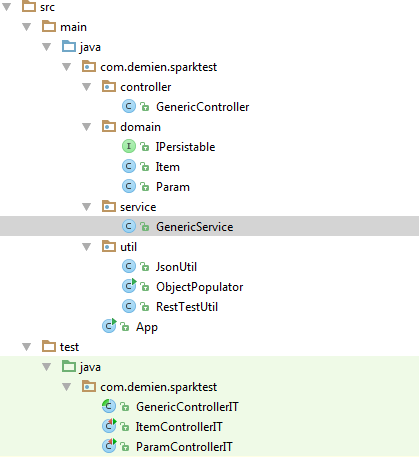
2. Application structure

Standard "mave-based" application structure:


3.Maven project(pom.xml) file

Just spark,slfj,gson and junit dependencies:

<?xml version="1.0" encoding="UTF-8"?><project xmlns="http://maven.apache.org/POM/4.0.0"         xmlns:xsi="http://www.w3.org/2001/XMLSchema-instance"         xsi:schemaLocation="http://maven.apache.org/POM/4.0.0 http://maven.apache.org/xsd/maven-4.0.0.xsd">
    <modelVersion>4.0.0</modelVersion>

    <groupId>com.demien</groupId>
    <artifactId>sparktest</artifactId>
    <version>1.0-SNAPSHOT</version>

    <dependencies>
    <dependency>
        <groupId>com.sparkjava</groupId>
        <artifactId>spark-core</artifactId>
        <version>2.0.0</version>
    </dependency>
    <dependency>
        <groupId>org.slf4j</groupId>
        <artifactId>slf4j-simple</artifactId>
        <version>1.7.7</version>
    </dependency>
        <dependency>
            <groupId>com.google.code.gson</groupId>
            <artifactId>gson</artifactId>
            <version>2.2.4</version>
        </dependency>
        <dependency>
            <groupId>junit</groupId>
            <artifactId>junit</artifactId>
            <version>4.12</version>
        </dependency>

    </dependencies>


</project>


4. Domain objects

For my POJO data objects i created interface  IPersistable
public interface IPersistable {
    Long getId();
    void setId(Long id);

}

For having ability to operate ID field(by getId method) in controllers and test classes. So, all my domain objects are implementing this interface :

public class Item implements IPersistable {

    private Long id;
    private String name;
    private Long parentId;

public class Param implements IPersistable {

    private Long id;
    private String name;
    private String dataType;
    private Item item;

5. Controller

As I mentioned before, I'm too lazy, so I want to move common operations like "add", "get", "update", "delete" into one class :

package com.demien.sparktest.controller;

import com.demien.sparktest.util.JsonUtil;
import com.demien.sparktest.domain.IPersistable;
import com.demien.sparktest.service.GenericService;
import spark.Request;
import spark.Response;
import spark.Spark;

public class GenericController<T extends IPersistable> {
    private GenericService<T> service;
    private Class<T> cl;

    public GenericController(String basePath, Class<T> cl, GenericService<T> service) {
        this.cl=cl;
        this.service=service;
        Spark.get(basePath,this::getAll, JsonUtil::toJson);
        Spark.get(basePath+"/:id",this::getById, JsonUtil::toJson);
        Spark.get(basePath+"/test",this::test, JsonUtil::toJson);
        Spark.post(basePath,this::add, JsonUtil::toJson);
        Spark.put(basePath,this::update, JsonUtil::toJson);
        Spark.delete(basePath,this::delete, JsonUtil::toJson);
    }

    public Object test(Request request, Response response) {
        return "Hello world!";
    }

    public Object getAll(Request request, Response response) {
        return service.getAll();
    }

    public Object getById(Request request, Response response) {
        String id = request.params(":id");
        return service.getById(Long.parseLong(id));
    }

    public T restoreObjectFromRequest(Request request) {
        return (T)JsonUtil.toObject(request.body(),cl);
    }

    public Object add(Request request, Response response) {
        return service.add(restoreObjectFromRequest(request));
    }

    public Object update(Request request, Response response) {
        return service.update(restoreObjectFromRequest(request));
    }

    public Object delete(Request request, Response response) {
        service.delete(restoreObjectFromRequest(request));
        return "";
     }


}

So, now, for my entities(item and param) I have just to extend this class, without creation of controllers  :
GenericController<Item> itemController=new GenericController<Item>(ITEM_PATH, Item.class, itemService);
GenericController<Param> paramController=new GenericController<Param>(PARAM_PATH, Param.class, paramService);


6. "Dummy" service. 

It's just a simple demo project, so I decided not to use Hibernate, and created simple class for storing objects in a HashMap :

package com.demien.sparktest.service;

import com.demien.sparktest.domain.IPersistable;

import java.util.ArrayList;
import java.util.HashMap;
import java.util.List;
import java.util.Map;

public class GenericService<T extends IPersistable> {
    private Long maxId=0L;

    private Map<Long, T> storage=new HashMap<Long, T>();

    public void clearStorage() {
        storage.clear();
    }

    public T getById(Long id) {
        return storage.get(id);
    }

    public T add(T element) {
        Long id=element.getId();
        if (id==null) {
            maxId++;
            element.setId(maxId);
        } else {
            if (maxId.longValue()<id.longValue()) {
                maxId=id+1;
            }
        }
        return update(element);
    }

    public List<T> getAll() {
        List<T> result=new ArrayList<T>();
        for (T element:storage.values()) {
            result.add(element);
        }
        return result;
    }

    public T update(T element) {
        storage.put(element.getId(), element);
        return storage.get(element.getId());
    }

    public void delete(T element) {
        storage.remove(element.getId());
    }

}

7. Main application file. 

Spark is running just like regular java application. In main() procedure i have to "start" my controllers :
package com.demien.sparktest;

import com.demien.sparktest.controller.GenericController;
import com.demien.sparktest.domain.Param;
import com.demien.sparktest.service.GenericService;
import spark.Spark;
import com.demien.sparktest.domain.Item;

public class App {

    public final static int SPARK_PORT=8080;
    public final static String APP_PATH="http://localhost:"+SPARK_PORT;

    public final static GenericService<Item> itemService=new GenericService<>();
    public final static String ITEM_PATH="/item";

    public final static GenericService<Param> paramService=new GenericService<>();
    public final static String PARAM_PATH="/param";

    public static void main(String[] args) {
        Spark.setPort(8080);
        GenericController<Item> itemController=new GenericController<Item>(ITEM_PATH, Item.class, itemService);
        GenericController<Param> paramController=new GenericController<Param>(PARAM_PATH, Param.class, paramService);
    }

}

8. Utils

Also I had to create few simple utils :


8.1. JsonUtil  - just for conversion json<=>object

package com.demien.sparktest.util;

import com.google.gson.Gson;

public class JsonUtil {
    public static String toJson(Object object) {
        return new Gson().toJson(object);
    }

    public static Object toObject(String json, Class<?> cl) {
        return new Gson().fromJson(json, cl);
    }
}


8.2. RestTestUtil  - for testing : sending requests 

package com.demien.sparktest.util;

import java.io.*;
import java.net.HttpURLConnection;
import java.net.URL;
import java.nio.charset.StandardCharsets;

public class RestTestUtil {

    public static class RequestResult {

        public final String body;
        public final int status;

        private RequestResult(int status, String body) {
            this.body = body;
            this.status = status;
        }
    }

    public static RequestResult sendRequest(String method, String path, String urlParameters) throws IOException {

        URL url = new URL(path);
        HttpURLConnection conn = (HttpURLConnection) url.openConnection();
        conn.setDoOutput(true);
        conn.setInstanceFollowRedirects(false);
        conn.setRequestMethod(method);

        if (urlParameters!=null) {
            byte[] postData = urlParameters.getBytes(StandardCharsets.UTF_8);
            int postDataLength = postData.length;

            conn.setRequestProperty("Content-Type", "application/x-www-form-urlencoded");
            conn.setRequestProperty("charset", "utf-8");
            conn.setRequestProperty("Content-Length", Integer.toString(postDataLength));
            conn.setUseCaches(false);
            conn.getOutputStream().write(postData);
        }

        Reader in = new BufferedReader(new InputStreamReader(conn.getInputStream(), "UTF-8"));
        StringBuilder sb = new StringBuilder();
        for (int c; (c = in.read()) >= 0; )
            sb.append((char) c);
        String responseBody = sb.toString();
        int responseCode=conn.getResponseCode();
        return new RequestResult(responseCode, responseBody);

    }

    public static RequestResult sendRequest(String method, String path) throws IOException {
        return sendRequest(method, path, null);
    }


}

8.3 object populator - for testing : to "fill" test object with random generated data. 

package com.demien.sparktest.util;

import com.demien.sparktest.domain.IPersistable;
import com.demien.sparktest.domain.Item;

import java.lang.reflect.Field;
import java.util.ArrayList;
import java.util.Date;
import java.util.List;

public class ObjectPopulator {

    interface RandomGenerator {
        Object getRandomValue();
    }

    enum DataType {
        Integer(() -> {
            return new Integer((int) (Math.random() * 1000));
        }),
        Long(() -> {
            return new Long((long) (Math.random() * 1000));
        }),
        Date(()-> {
            return new Date(new Date().getTime() - (int) (Math.random() * 1000 * 60 * 60 * 24 * 100));
        }),
        String(() -> {
            StringBuffer result = new StringBuffer();
            String[] letters = new String[]{"A", "B", "C", "D", "E", "F", "G"};
            int length = (int) (Math.random() * 15) + 5;
            for (int i = 0; i < length; i++) {
                int pos = (int) (Math.random() * letters.length);
                result.append(letters[pos]);
            }
            return result.toString();
        }
        );

        private RandomGenerator generator;

        DataType(RandomGenerator generator) {
            this.generator = generator;
        }

        Object getRandomValue() {
            return generator.getRandomValue();
        }
    }

    public static Object populate(IPersistable instance) throws IllegalAccessException {
        List<Field> fields = getAllFields(instance);
        for (Field eachField : fields) {
            eachField.setAccessible(true);
            String typeName=eachField.getType().getSimpleName();
            if (eachField.getType().getTypeName().startsWith("com.demien")) {
                Object obj=null;
                try {
                     obj=eachField.getType().newInstance();
                } catch (InstantiationException e) {
                    e.printStackTrace();
                }
                obj=populate((IPersistable) obj);
                eachField.set(instance, obj);
            } else {
                DataType dataType = DataType.valueOf(typeName);
                eachField.set(instance, dataType.getRandomValue());
            }
        }
        return instance;
    }


    private static List<Field> getAllFields(Object instance) {
        Field[] fields = instance.getClass().getDeclaredFields();
        List<Field> result = new ArrayList<Field>();
        for (int i = 0; i < fields.length; i++) {
            if (!java.lang.reflect.Modifier.isFinal(fields[i].getModifiers())
                    && !java.lang.reflect.Modifier.isStatic(fields[i]
                    .getModifiers())) {
                result.add(fields[i]);
            }
        }
        return result;
    }

 
}

9. Generic integration test class

For base operations i created generic controller test class - other controllers will just extend it :
package com.demien.sparktest;

import com.demien.sparktest.domain.IPersistable;
import com.demien.sparktest.service.GenericService;
import com.demien.sparktest.util.JsonUtil;
import com.demien.sparktest.util.ObjectPopulator;
import com.demien.sparktest.util.RestTestUtil;
import org.junit.*;
import spark.Spark;

import java.util.List;

public abstract class GenericControllerIT<T extends IPersistable> {
    private String fullPath;
    private Class<T> cl;
    private GenericService<T> service;

    public GenericControllerIT(String basePath, Class<T> cl, GenericService<T> service){
        this.fullPath= App.APP_PATH+basePath;
        this.cl=cl;
        this.service=service;
    }

    @BeforeClass    public static void init() {
        App.main(null);
        try {
            Thread.sleep(5000);
        } catch (InterruptedException e) {
            e.printStackTrace();
        }
    }

    @AfterClass    public static void tearDown() {
        Spark.stop();
    }

    @Before    public void initTest() {
        service.clearStorage();
    }

    T getTestObject() throws Exception {
        T testObject=cl.newInstance();
        ObjectPopulator.populate(testObject);
        return testObject;
    }

    @Test    public void addTest() throws Exception {
        T testObject=getTestObject();
        RestTestUtil.RequestResult res= RestTestUtil.sendRequest("POST", fullPath, JsonUtil.toJson(testObject));
        Assert.assertEquals(200, res.status);
        Assert.assertEquals(service.getById(testObject.getId()), testObject);
    }

    @Test    public void getTest() throws Exception {
        T testObject=getTestObject();
        service.add(testObject);
        RestTestUtil.RequestResult res= RestTestUtil.sendRequest("GET", fullPath +"/"+testObject.getId());
        Assert.assertEquals(200, res.status);
        T receivedObject=(T)JsonUtil.toObject(res.body, cl);
        Assert.assertEquals(testObject, receivedObject);
    }

    @Test    public void getAllTest() throws Exception {
        T testObject1=getTestObject();
        service.add(testObject1);
        T testObject2=getTestObject();
        service.add(testObject2);
        RestTestUtil.RequestResult res= RestTestUtil.sendRequest("GET", fullPath);
        Assert.assertEquals(200, res.status);
        List<T> receivedObjectList=(List<T>)JsonUtil.toObject(res.body, java.util.List.class);
        Assert.assertTrue(receivedObjectList.size()==2);
    }


    @Test    public void updateTest() throws Exception {
        T testObject=getTestObject();
        service.add(testObject);
        T updatedObject=getTestObject();
        updatedObject.setId(testObject.getId());

        RestTestUtil.RequestResult res= RestTestUtil.sendRequest("PUT", fullPath, JsonUtil.toJson(updatedObject));
        Assert.assertEquals(200, res.status);

        T updatedObjectFromService=service.getById(testObject.getId());
        Assert.assertEquals(updatedObject, updatedObjectFromService);
    }

    @Test    public void deleteTest() throws Exception {
        T testObject=getTestObject();
        service.add(testObject);

        RestTestUtil.RequestResult res= RestTestUtil.sendRequest("DELETE", fullPath, JsonUtil.toJson(testObject));
        Assert.assertEquals(200, res.status);

        T deletedObject=service.getById(testObject.getId());
        Assert.assertNull(deletedObject);
    }


}


10. Integration test classes for ItemController and ParamController. 

Now we can just extend GenericControlerIT class and all tests for base operation will be inherited :

package com.demien.sparktest;

import com.demien.sparktest.domain.Item;

public class ItemControllerIT extends GenericControllerIT<Item> {
    public ItemControllerIT() {
        super(App.ITEM_PATH, Item.class, App.itemService);
    }
}


package com.demien.sparktest;

import com.demien.sparktest.domain.Param;

public class ParamControllerIT extends GenericControllerIT<Param> {
    public ParamControllerIT() {
        super(App.PARAM_PATH, Param.class, App.paramService);
    }
}

11. The end

Complete source code can be downloaded from here.
Sunday, July 26, 2015

Spring Integration - simple example


1. intro 

From wiki: Spring Integration is an open source framework for enterprise application integration. It is a lightweight framework that builds upon the core Spring framework. It is designed to enable the development of integration solutions typical of event-driven architectures and messaging-centric architectures.

In shorts, Spring integration is a framework wich can help in creation application with complex data flows, with a lot of different data transformation, filtering, routing and others. 

Schema of flow in this example : 


Description : 
we have collection of payments, this collection is splitting and sending "one by one" into next step : Filter. Filter just allows to go ahead payments with amount!=nll. After that(router), we have 2 types of workflow regarding property isVip: one workflow for regular payments(regular transformer) , another one for vip payments : vip transformer. Results of transformation are sending into paymentProcessor in which has to main logic of our application. In case when we have errors in processing - we are processing errors in fail processor.  


2. Component description. 


    • Inbound Gateways --- bring data from an external system to the integration network, and expect a response message to be provided by some other components, through some channel, to be forward to the external system
    • Channels --- the connectors between the other types of components, i.e. the endpoints. (These are the "pipes" in the "pipes&filters" architectural characterization.) Channels provide a simple API defined in-terms of message passing operations, such as send() and recv() methods.
    •  message router is an endpoint that forwards incoming messages to one (or more) among several configured output channels. The criteria for selecting the output channel is usually based on the message payload and/or the message headers. 

    • Message filters are endpoints that selectively relay messages from an input to an output channel. They can be used to discard messages based on payload or header values, detect invalid messages, or relay non-conforming messages to a separte channel.
    • Message transformers are endpoints that transform messages payload and/or headers. The can be used to perform arbitrary transformations on the payload, convert payload types, and add, change, or remove headers. 
    • The Splitter is a component whose role is to partition a message in several parts, and send the resulting messages to be processed independently. Very often, they are upstream producers in a pipeline that includes an Aggregator.

3. Project structure


4. Main project (pom) file


<?xml version="1.0" encoding="UTF-8"?>
<project xmlns="http://maven.apache.org/POM/4.0.0"
         xmlns:xsi="http://www.w3.org/2001/XMLSchema-instance"
         xsi:schemaLocation="http://maven.apache.org/POM/4.0.0 http://maven.apache.org/xsd/maven-4.0.0.xsd">
    <modelVersion>4.0.0</modelVersion>

    <groupId>com.demien</groupId>
    <artifactId>spring-integration-demo</artifactId>
    <version>1.0-SNAPSHOT</version>

    <dependencies>
        <dependency>
            <groupId>org.springframework</groupId>
            <artifactId>spring-context</artifactId>
            <version>3.2.1.RELEASE</version>
        </dependency>
        <dependency>
            <groupId>org.springframework.integration</groupId>
            <artifactId>spring-integration-core</artifactId>
            <version>2.2.2.RELEASE</version>
        </dependency>

        <dependency>
            <groupId>log4j</groupId>
            <artifactId>log4j</artifactId>
            <version>1.2.16</version>
        </dependency>
        <dependency>
            <groupId>com.google.guava</groupId>
            <artifactId>guava</artifactId>
            <version>13.0.1</version>
        </dependency>
        <dependency>
            <groupId>org.testng</groupId>
            <artifactId>testng</artifactId>
            <version>6.5.2</version>
        </dependency>
    </dependencies>

    <build>
        <plugins>
            <plugin>
                <groupId>org.apache.maven.plugins</groupId>
                <artifactId>maven-compiler-plugin</artifactId>
                <configuration>
                    <source>1.6</source>
                    <target>1.6</target>
                </configuration>
            </plugin>
        </plugins>
    </build>

</project>

5. Context file

Here described all component of application.  Please take a look how implemented logging: interceptors in channels.

<?xml version="1.0" encoding="UTF-8"?>
<beans xmlns="http://www.springframework.org/schema/beans"
       xmlns:xsi="http://www.w3.org/2001/XMLSchema-instance"
       xmlns:task="http://www.springframework.org/schema/task"
       xmlns:context="http://www.springframework.org/schema/context"
       xmlns:int="http://www.springframework.org/schema/integration"
       xsi:schemaLocation="http://www.springframework.org/schema/beans
                           http://www.springframework.org/schema/beans/spring-beans.xsd
                           http://www.springframework.org/schema/task
                           http://www.springframework.org/schema/task/spring-task.xsd
                           http://www.springframework.org/schema/context
                           http://www.springframework.org/schema/context/spring-context.xsd
                           http://www.springframework.org/schema/integration
                           http://www.springframework.org/schema/integration/spring-integration.xsd"
        >

    <bean id="auditInterceptor" class="com.demien.spring.integration.interceptor.LogInterceptor"/>

    <int:channel id = "newPaymentChannel">
        <int:interceptors>
            <ref bean="auditInterceptor"/>
        </int:interceptors>
    </int:channel>

    <int:gateway id="inPaymentGateway"
                 service-interface="com.demien.spring.integration.gateways.LoadPaymentsGateway">
        <int:method name="loadPayments" request-channel="newPaymentChannel" />
    </int:gateway>

    <int:splitter
            input-channel="newPaymentChannel"
            output-channel="singlePaymentChannel" />
    <int:channel id = "singlePaymentChannel">
        <int:interceptors>
            <ref bean="auditInterceptor"/>
        </int:interceptors>
    </int:channel>


    <int:filter
            input-channel="singlePaymentChannel"
            output-channel="filteredPaymentChannel"
            ref="paymentFilter" />
    <int:channel id = "filteredPaymentChannel">
        <int:interceptors>
            <ref bean="auditInterceptor"/>
        </int:interceptors>
    </int:channel>
    <bean id="paymentFilter" class="com.demien.spring.integration.filters.PaymentFilter"/>

    <int:recipient-list-router input-channel="filteredPaymentChannel">
        <int:recipient channel = "regularPayments" selector-expression="!payload.isVip()"/>
        <int:recipient channel = "vipPayments" selector-expression="payload.isVip()" />
    </int:recipient-list-router>
    <int:channel id = "regularPayments">
        <int:interceptors>
            <ref bean="auditInterceptor"/>
        </int:interceptors>
    </int:channel>
    <int:channel id = "vipPayments">
        <int:interceptors>
            <ref bean="auditInterceptor"/>
        </int:interceptors>
    </int:channel>
    <int:transformer
            input-channel="regularPayments"
            output-channel="processingChannel"
            ref="regularPaymentTransformer" />
    <int:transformer
            input-channel="vipPayments"
            output-channel="processingChannel"
            ref="vipPaymentTransformer" />
    <int:channel id = "processingChannel">
        <int:queue capacity="10" />
        <int:interceptors>
            <ref bean="auditInterceptor"/>
        </int:interceptors>
    </int:channel>
    <bean id="regularPaymentTransformer" class="com.demien.spring.integration.transformers.RegularPaymentTransformer"/>
    <bean id="vipPaymentTransformer" class="com.demien.spring.integration.transformers.VipPaymentTransformer"/>


    <int:service-activator input-channel="processingChannel" ref="paymentProcessor">
        <int:poller fixed-rate="100" error-channel="failedPaymentsChannel" />
    </int:service-activator>
    <bean id="paymentProcessor" class="com.demien.spring.integration.activators.PaymentServiceActivator"/>

    <int:channel id = "failedPaymentsChannel">
        <int:interceptors>
            <ref bean="auditInterceptor"/>
        </int:interceptors>
    </int:channel>


    <int:service-activator input-channel="failedPaymentsChannel" ref="failProcessor" />
    <bean id="failProcessor" class="com.demien.spring.integration.activators.FailedPaymentActivator"/>

</beans> 
 

6. Test dto(Payment)

Very simple object. Please take a look at method isVip- we will use it later.

package com.demien.spring.integration.dto;

import java.math.BigDecimal;
import java.util.Date;

public class Payment {
    BigDecimal amount;
    String description;

    public Payment(String description, BigDecimal amount) {
        this.description = description;
        this.amount = amount;
    }

    public boolean isVip() {
        if (amount!=null && amount.compareTo(new BigDecimal(10000))==1) {
            return true;
        } else {
            return false;
        }
    }

    public BigDecimal getAmount() {
        return amount;
    }

    public void setAmount(BigDecimal amount) {
        this.amount = amount;
    }

    public String getDescription() {
        return description;
    }

    public void setDescription(String description) {
        this.description = description;
    }


    @Override
    public String toString() {
        return "Payment{" +
                "amount=" + amount +
                ", description='" + description + '\'' +
                '}';
    }
}


7. Interceptors

As I mentioned before - we will use interceptor for logging messages which came into channel. 

package com.demien.spring.integration.interceptor;

import org.springframework.integration.Message;
import org.springframework.integration.MessageChannel;
import org.springframework.integration.channel.interceptor.ChannelInterceptorAdapter;

public class LogInterceptor extends ChannelInterceptorAdapter {

    public Message<?> preSend(Message<?> message,
                              MessageChannel channel) {
        System.out.println("[["+channel.toString()+"]] "+message.getPayload());
        return message;
    }

}

8. Filters

We can filter object which came into channel. In this example, if received object don't have amount - it will be filtered (and will not move forward).

package com.demien.spring.integration.filters;

import com.demien.spring.integration.dto.Payment;
import org.springframework.integration.annotation.Filter;

public class PaymentFilter {

    @Filter
    public boolean checkMandatoryFields(Payment payment) {
        if (payment==null || payment.getAmount()==null) {
            System.out.println("REJECTED:"+payment);
            return false;
        } else {
            return true;
        }
    }
}

9. Transformers

I made 2 branches of workflow here : 2 transformers : for regular and vip payments. 


package com.demien.spring.integration.transformers;

import com.demien.spring.integration.dto.Payment;

public interface PaymentTransformer {
    String paymentToSting(Payment payment);
} 


package com.demien.spring.integration.transformers;

import com.demien.spring.integration.dto.Payment;
import org.springframework.integration.annotation.Transformer;

public class RegularPaymentTransformer implements PaymentTransformer {

    @Override
    @Transformer
    public String paymentToSting(Payment payment) {
        return payment.getDescription()+" "+payment.getAmount();
    }


} 


package com.demien.spring.integration.transformers;

import com.demien.spring.integration.dto.Payment;
import org.springframework.integration.annotation.Transformer;

public class VipPaymentTransformer implements PaymentTransformer {

    @Override
    @Transformer
    public String paymentToSting(Payment payment) {
        return "!!! "+ " VIP PAYMENT:"+payment.getDescription()+" "+payment.getAmount();
    }
}

10. Activators

Usually, the main processing logic. In this example I just printed in-object.

package com.demien.spring.integration.activators;

import org.springframework.integration.annotation.ServiceActivator;

public class PaymentServiceActivator {

    @ServiceActivator
    public void processPayment(String payment) throws Exception {
         if (payment.toUpperCase().contains("TEST")) {
             throw new Exception("Test payment was not processed");
         }
        // some logic have to be here
        System.out.println("PROCESSED:"+payment);
    }
}

package com.demien.spring.integration.activators;

import org.springframework.integration.Message;
import org.springframework.integration.MessageHandlingException;
import org.springframework.integration.annotation.ServiceActivator;

public class FailedPaymentActivator {
    @ServiceActivator
    public void handleFailedOrder(Message<MessageHandlingException> message) {
        String payment=(String)message.getPayload().getFailedMessage().getPayload();
        System.out.println("FAILED:"+payment+" WITH ERROR:"+message.getPayload().getMessage());
    }
}

11. Main starter file

Here I'm creating 4 test objects and sending them into workflow by gateway. 

package com.demien.spring.integration;

import com.demien.spring.integration.dto.Payment;
import com.demien.spring.integration.gateways.LoadPaymentsGateway;
import org.springframework.context.support.ClassPathXmlApplicationContext;

import java.math.BigDecimal;
import java.util.ArrayList;
import java.util.List;

public class App {

    static LoadPaymentsGateway gateway;

    public static void main(String[] args) {
        ClassPathXmlApplicationContext context=new ClassPathXmlApplicationContext("/expences-context.xml");

        Payment payment1=new Payment("First payment", new BigDecimal(666) );
        Payment payment2=new Payment("Second payment", new BigDecimal(20000) );
        Payment payment3=new Payment("Null payment", null );
        Payment payment4=new Payment("Test payment", new BigDecimal(1) );


        List<Payment> payments=new ArrayList<Payment>();
        payments.add(payment1);
        payments.add(payment2);
        payments.add(payment3);
        payments.add(payment4);

        gateway=(LoadPaymentsGateway)context.getBean("inPaymentGateway");


        gateway.loadPayments(payments);
        context.close();
    }
}

12. Results

I ordered strings in log in order of processing. So we can see what newPaymentChannel received collection of 4 objects. After that they were sent one-by-one into singlePaymentChannel. Filtered payment channel got only 3 objects : one was rejected because of null amount. Later based on value of amount (and property isVip) 2objects were sent into regularPayments and 1 - vipPayments, and transformed by corresponding transformers into another objects(into Strings in this example). At the end transformed objects were processed by PaymentServiceActivators(processingChannel). Rejected objects are moving forward to failedPaymentChannel and processed by FailedServiceActivator.   
 

[[newPaymentChannel]] [Payment{amount=666, description='First payment'}, Payment{amount=20000, description='Second payment'}, Payment{amount=null, description='Null payment'}, Payment{amount=1, description='Test payment'}]

[[singlePaymentChannel]] Payment{amount=666, description='First payment'}

[[singlePaymentChannel]] Payment{amount=20000, description='Second payment'}
[[singlePaymentChannel]] Payment{amount=null, description='Null payment'}
[[singlePaymentChannel]] Payment{amount=1, description='Test payment'}
  
[[filteredPaymentChannel]] Payment{amount=666, description='First payment'}
[[filteredPaymentChannel]] Payment{amount=20000, description='Second payment'}

[[filteredPaymentChannel]] Payment{amount=1, description='Test payment'}
REJECTED:Payment{amount=null, description='Null payment'}

[[regularPayments]] Payment{amount=666, description='First payment'}
[[regularPayments]] Payment{amount=1, description='Test payment'}

[[vipPayments]] Payment{amount=20000, description='Second payment'}

[[processingChannel]] First payment 666
PROCESSED:First payment 666


[[processingChannel]] !!!  VIP PAYMENT:Second payment 20000
PROCESSED:!!!  VIP PAYMENT:Second payment 20000
 

[[processingChannel]] Test payment 1
FAILED:Test payment 1 WITH ERROR:java.lang.Exception: Test payment was not processed

[[failedPaymentsChannel]] org.springframework.integration.MessageHandlingException: java.lang.Exception: Test payment was not processed


13. The end

Source code can be downloaded from here.